Photography of the installation view of the CREMASTER cycle in the Sammlung Goetz. Six flat screens are attached to a white duct in the center of the room, below which are vitrines of varying design containing various artifacts made, for example, to equip the cycle. Matthew Barney, Sammlung Goetz Munich
Sammlung Goetz

Matthew Barney

“I like to think the music can take you farther into the visual than the visual alone can. There’s a place where we can see and hear at the same time, without being aware of doing either: a state of awareness without concentration, which can only happen with this kind of accumulation of elements.” (Matthew Barney)

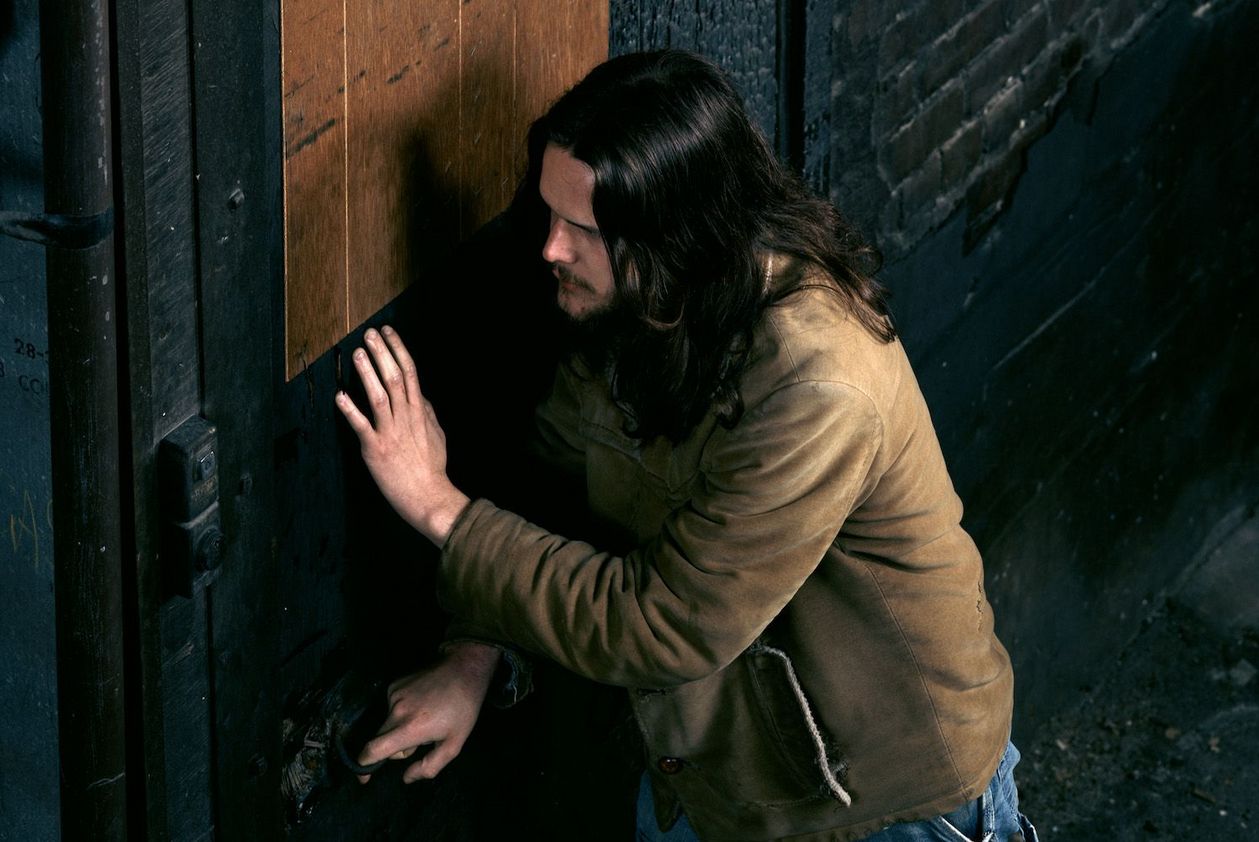
Matthew Barney‘s long-running DRAWING RESTRAINT series, which began in 1987, culminating in the 1989 work Field Dressing, merges two distinct themes: the body of the athlete as an energetic sculpture and the fetish character of workout equipment. In his first solo exhibitions in 1991, he presented installations featuring sculptures and videos that showed how he arrived at his drawings through interaction with various constructions and objects in conjunction with physical exertion and the struggle to overcome various hurdles. In the exhibition, seven photos from the series ENVELOPA: Drawing Restraint 7 (Guillotine) (1993) were scattered throughout the venue as links, while the major cinematic work Drawing Restraint 9 (2006) was screened in the BASE 103.
Barney began working on his monumental CREMASTER cycle in 1994 – a five-part film project complemented by photographs, drawings and sculptures (some of which were featured in his film sets or derived from them). At the heart of the exhibition, featuring works from the period 1992 to 2006, was the spatial sound sculpture of the CREMASTER cycle, with showcases accompanying each film.

What initially took the form of performances by the artist without an audience, eventually took shape as a poetic and at the same time disturbing work in the film DRAWING RESTRAINT 9. The act of overcoming adversity in order to draw was transposed into the medium of film and extended into the creation of a sculpture. DRAWING RESTRAINT 9 references the Japanese whaling vessel Nisshin Maru. The soundtrack was created by Icelandic musician Björk, who also plays a leading role in the film: it begins with a procession in a Japanese port, where a tanker carrying hot vaseline, oxen, horses and wild boar is accompanied to the ship and surrounded by hundreds of curious onlookers. The vaseline is pumped into a massive open mould on deck, where it cools over the course of several weeks en route to the Antarctic. Using the tools and techniques deployed in the whaling industry, the vaseline is eventually transformed into a sculpture that changes shape several times. The climax of the film involves the removal of the sculpture on arrival in the Southern Ocean, against a backdrop of icebergs. Parallel to this creation of an artwork, a love story develops below deck – played by Barney and Björk in accordance with the strict choreographical rules of the Japanese tea ceremony. In the course of the ceremony and the voyage, the tea room itself becomes a ‘cup’ filled with the warm liquid in which both of these western passengers are subjected to a mysterious physical transformation.
 

On the occasion of the exhibition Matthew Barney at the Sammlung Goetz from November 3, 2007 to March 29, 2008, the Munich Film Museum have shown some movies from the american artist.

CREMASTER 1, 1995, and CREMASTER 2, 1999
Friday, February 8, 2008, 9 p.m.
CREMASTER 3, 2002
Saturday, February 9, 2008, 9 p.m.
CREMASTER 4, 1994, and CREMASTER 5, 1997
Sunday, February 10, 2008, 9 p.m.
De Lama Lamina, 2004
Saturday, February 9, 2008, 6.30 p.m. and 7.45 p.m.
DRAWING RESTRAINT 9, 2005
Friday, February 8, 2008, 6.30 p.m.
Sunday, February 10, 2008, 6.30 p.m.

Matthew Barney

240 pages, 139 ill., hardcover
German/English
2007, Kunstverlag Ingvild Goetz GmbH, Hamburg
ISBN 978-3-939894-09-4
€ 25,00

learn more

Upcoming

Cyrill Lachauer. The Sunset Route

| Kunstpalais Erlangen

feat. Mike Brodie, Mouse Green, Rhyw, Mia Justice Smith, Moritz Stumm

In the exhibition The Sunset Route, on view at the Kunstpalais Erlangen and created in collaboration with the Sammlung Goetz, Cyrill Lachauer presents works from 2020 to 2025, a period during which he traveled on freight trains through the USA, Mexico, and Bosnia. In the spirit of poetic ethnography, he created photographs and films that are now being shown together for the first time. They all explore questions of freedom, self-determination, and resistance, as well as colonization, exclusion, and exploitation.


Laurie Simmons. Dollhouse Photographs

| Deutsches Theatermuseum

The American artist Laurie Simmons is known for her photographs featuring tiny dolls representing stereotypical female roles in domestic interiors. Her series In and Around the House (1978/79) is exemplary for this set-up photography. The series is the centerpiece of the exhibition, with 56 black-and-white images showing a doll occupied with the mundane chores of a housewife in the cozy environment of a dollhouse. The exhibition “Laurie Simmons: Dollhouse Photographs”, a collaboration of Sammlung Goetz, Deutsches Theatermuseum and FILMFEST MÜNCHEN, presents a selection of works by Simmons that cast a critical gaze at gender stereotypes in the American middle class.

Sterling Ruby

| Sammlung Goetz /Schaufenster

Los Angeles-based American artist Sterling Ruby is known for his cross-genre work, which ranges from ceramics and bronzes, collages and textiles, to enormous, spray-painted paintings. In his works, Ruby weaves together a variety of different autobiographical, art-historical, and sociological sources. Through deconstruction and reconstruction, he probes the idea of a non-hierarchical and borderless universe. The exhibition at the Sammlung Goetz /Schaufenster provides insight into his multi-layered artistic practice.


Jeff Wall

| Sammlung Goetz /Schaufenster

Canadian artist Jeff Wall is one of the most influential photographers of our time. In his elaborately staged pictorial compositions, he combines the narrative of cinema with painting. Wall became known for his large-format lightbox images, which are formally more reminiscent of the world of advertising than that of fine art. With this technique, he revolutionized the medium of photography, elevating it to the height of painting and sculpture. The exhibition at the Sammlung Goetz /Schaufenster presents a selection of his iconic lightbox images from the 1990s.

further exhibitions

view archive